 Andrej C.
A lot of projects start with a simple sentence:
“We need a new website.”
Fair enough.
Sometimes you actually do. Sometimes you don’t.
And sometimes you need a website — but the website is the least interesting part of the whole thing.
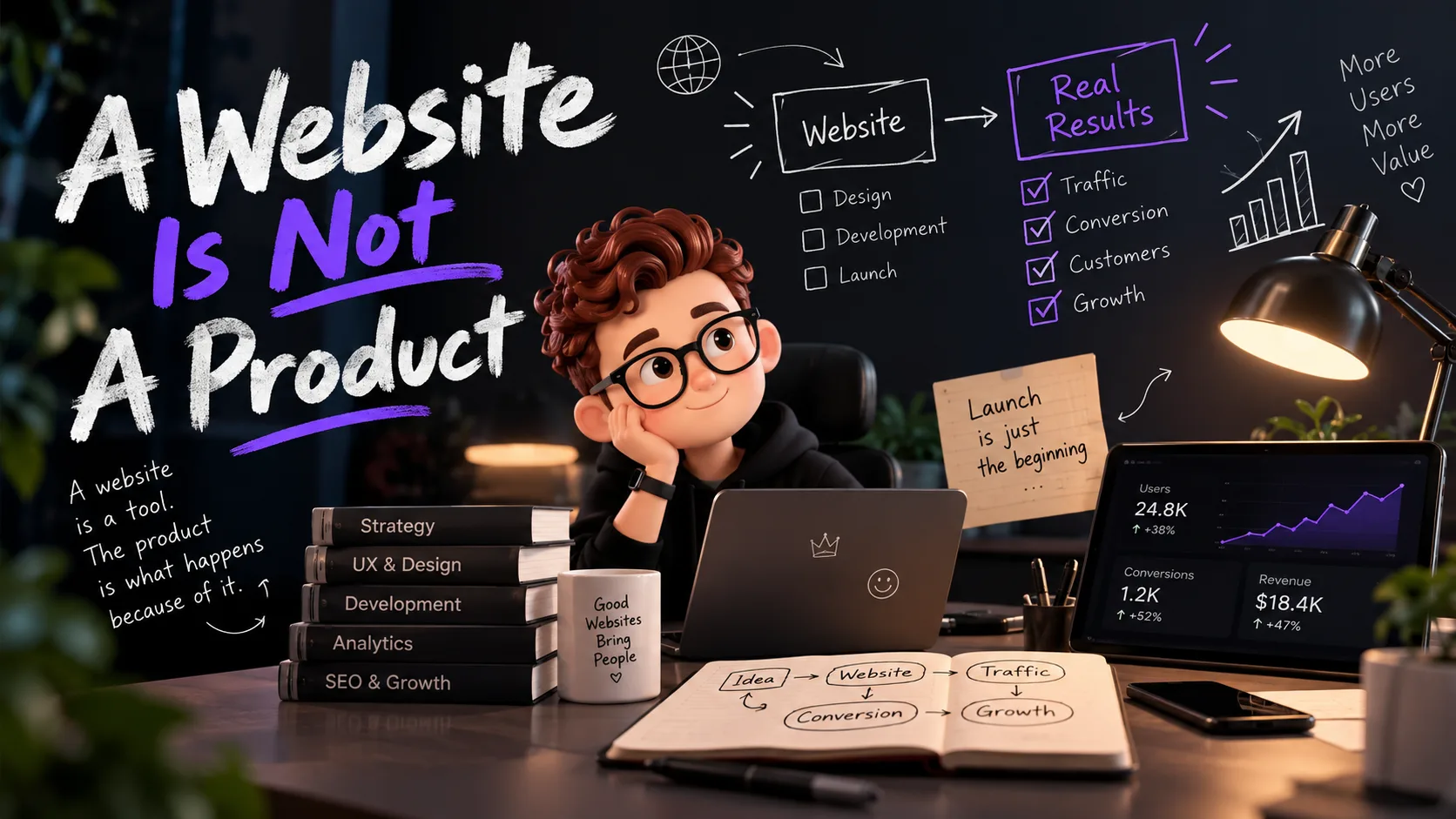
Because a website is not a product.
It’s a tool.
The product is what happens because of it.
Getting the website is the easy part
There is a very straightforward way to build a website.
You define the scope, agree on the budget, design it, develop it, test it, launch it.
Done.
Everyone gets their files. The invoice gets paid. The website goes live.
And then… nothing.
No new traffic. No new experiments. No meaningful changes. No one really knows what users are doing.
The website slowly becomes a very expensive digital business card.
This is probably one of the most common problems we see.
Not because the website is bad.
Because the website was treated as a finished object instead of an active business tool.
So, should you even build one?
Before we start a project, we want to understand what the website is actually supposed to do.
Maybe you need to generate leads. Maybe you need to sell products. Maybe you need to explain a complicated service. Maybe you need to build trust before someone talks to your sales team. Maybe you need to recruit people. Maybe you genuinely just need a simple online presence.
All of these are valid.
But they are very different products.
And they require different decisions around design, development, analytics, content, SEO, acquisition and everything that happens after launch.
That’s why the first question isn’t always: “What kind of website do you want?”
Sometimes it’s: “What should happen because this website exists?”
Launch day is when things get interesting
We actually like the moment after launch more than the moment before it.
Before launch, you have assumptions. After launch, you have reality.
People start using the product. They click things you didn’t expect them to click. They ignore things you thought were important. They drop off somewhere in the funnel. They come back. They don’t come back.
Now you have something to work with.
This is where analytics become useful.
Not because dashboards are exciting, but because they turn guesses into questions.
Why are people leaving here? Why does this page perform better? Why do users add something to their cart but not finish the checkout? Why does one acquisition channel bring visitors who actually convert while another just brings traffic?
The answers lead to changes.
And the changes lead to more answers.
That loop is the real product development.
One of our favourite examples
We worked with Volmi — an e-commerce platform focused on health and wellness products.
The problem wasn’t simply that the old website looked outdated.
The bigger problem was what happened when people actually tried to buy something.
The checkout process was unnecessarily complicated and contained errors. So instead of treating the project as “let’s make a nicer website”, we looked at the whole journey.
We reworked the checkout, improved the visual experience and added a much deeper layer of tracking.
The important part wasn’t just making the interface nicer.
It was making the journey understandable.
Where does someone enter? What do they do? Where do they hesitate? Where do they leave? What happens before the purchase? What happens after?
Once you can see the journey, you can start improving it.
The part nobody budgets for
This is probably the biggest problem with the way websites are usually bought.
Companies are often ready to pay for the website.
They are less ready to pay for what happens after the website.
Development has a clear finish line. Growth doesn’t.
You can build the website today and spend the next three years figuring out how to make it better.
SEO needs time. Content needs time. Advertising needs testing. Analytics need interpretation.
Users change. Markets change. The business itself changes.
A website that worked perfectly six months ago might be solving the wrong problem today.
That doesn’t mean every website needs a huge permanent budget.
It means you should know what happens after launch before you decide what you’re building.
Build less. Learn more.
We’re not against websites. We build a lot of them.
We’re against building something just because “having a website” feels like progress.
Sometimes the right answer is a simple website. Sometimes it’s a much more complex platform. Sometimes the answer is to fix the existing one instead of rebuilding everything.
And sometimes the right answer is to spend the budget on getting people to the website rather than making the website prettier.
There isn’t one universal answer.
There is only the problem you’re trying to solve.
So, what is the product?
Maybe it’s the website. Maybe it’s the checkout. Maybe it’s the lead. Maybe it’s the first conversation with a customer. Maybe it’s the entire journey from an ad impression to a purchase.
The website is just one part of that system.
A website is a tool. The product is what happens because of it.
And that’s why, for us, launch day isn’t the finish line.
It’s when we finally get to see if it works.